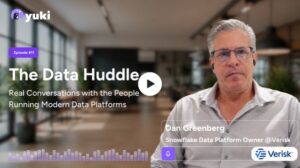
The Data Huddle by Yuki is a podcast about modern data leaders at global companies. The people who make data work every day, but rarely get the spotlight.
Honest conversations about their careers, wins, mistakes, and how they see the future of AI and data. What does it actually take to scale AI, data, and infrastructure at the same time, without breaking the business?
In this episode, Dana Bilder-Morozova sits down with Mathew Paruthickal, Global Head of Data Architecture and AI Engineering at Sanofi (Opella), for a refreshingly practical conversation about building AI that survives the enterprise. Not the demo version. The production version.
On This Episode
Everyone wants “agents.” Most companies are skipping the part that makes agents safe: trust.
Mathew’s thesis is simple and uncomfortable: scale trust before you scale agents. AI without context is just noise. And AI without trust never leaves the pilot.
They covered a lot of ground: how data evolved from warehouses to big data to AI, why “generic chatbots” don’t move the needle, what actually breaks when enterprises scale fast, and how to think about building an enterprise IQ layer that captures not only what the company knows, but how it acts.
About the Guest
Mathew Paruthickal is the Global Head of Data Architecture and AI Engineering at Sanofi’s consumer healthcare business (Opella), where he focuses on scaling AI in complex, real world environments. Before that, he spent time at McKinsey working with large enterprises on data and AI strategy.
He’s been in data for 15+ years and still talks about it like it’s day one. “Data is the oil… the alphabets that eventually make the language that we speak.” That energy shows up in how he thinks about platforms, governance, and what it takes to modernize without pausing the business.
Episode Highlights
Scale Trust Before You Scale Agents
Mathew’s line should be taped above every “AI roadmap” slide:
“Scale the trust before you can scale the agents.”
The hype is real: people talk about deploying thousands of agents in a week. But most of those efforts collapse when the organization asks basic questions:
Where did this answer come from?
Which definition did it use?
Who approved this decision path?
Can we audit it?
Can we keep it running when costs spike?
His point is not anti-agent. It’s pro-foundation. Trust is the prerequisite. Without it, you get lots of activity and very little adoption.
From Data Platforms to Decision Systems
Mathew doesn’t describe his job as “building dashboards.” He describes it as building an enterprise-grade decision system, what he calls an agentic decision intelligence system.
That shift matters. A data platform helps you see what happened. A decision system helps you decide what to do next, faster, with guardrails, and with a clear link to business outcomes.
Operational Intelligence vs Decision Intelligence
A lot of AI investments still live in “operational intelligence”: automating repetitive processes like invoices, workflows, and tickets.
Mathew’s focus is the harder category: decision intelligence. That’s where enterprises need one coherent platform that brings together structured data (your Snowflake, Databricks, pipelines) and unstructured knowledge (SharePoint, Confluence, documents, local playbooks) into one place where humans and AI can reason together.
“Buy the Plumbing, Own the Brain”
If you’re rebuilding your stack today, Mathew’s build vs buy stance is crisp:
Buy the commodity.
Own the strategic intelligence.
You can buy cloud, storage, compute, BI, observability, and platform capabilities. What you cannot outsource is the thing that makes your business different: domain definitions, workflows, constraints, and how decisions get made. “You buy the plumbing, but you own the brain.”
Modernizing While the Business Keeps Moving
One of the most relatable parts of the episode is also the least glamorous: sequencing.
You can’t tell the business to pause while you rebuild everything. Your existing products and reports keep running. Your users keep asking questions. Meanwhile you are building the future: context layers, governance, new operating models, new AI workflows. The hard part is building tomorrow without breaking today.
How Mathew Filters the AI Noise
Mathew gets “tons of demos” and hears the same promises everyone else does. His filter is the enterprise reality test:
Can it survive cost, scale, reliability demands?
Does it have governance?
Does it have metrics?
Can it run in production, not just on stage?
“Demos with no context… no governance… no metrics… there’s no production.”
The Future: Five Moves Great Companies Will Make
Mathew’s view of 2027–2028 is not “more shiny tools.” It’s five fundamentals:
- Build a trusted semantic and context layer
- Encode domain intelligence: playbooks, workflows, skills
- Treat governance as an enabler of scale
- Measure AI by business outcomes, not demos
- Redesign how decisions are made, then scale specialized agents
Who Owns AI Decisions? The Operating Model Has to Change
When Dana asks who owns AI decisions today, Mathew doesn’t pick a single function. Data, engineering, and business all own it, because the operating model has to evolve.
His argument: fast AI pipelines are pointless if the organization can’t safely connect them to the way the company actually works. That means embedding data and AI leaders closer to the business, defining playbooks per domain and country, and shipping capabilities through a controlled platform that provides stability and governance.
It also means meeting teams where they already work. People will ask questions in Slack, Teams, or low-code tools. The goal is not to force everyone into one portal, but to make those interactions interoperable and still governed. That’s how “institutional AI” happens: the company learns as a system, not as a collection of isolated copilots.
The Bottom Line
Agents are easy to prototype. Trust is hard to build.
If you want AI that scales in an enterprise, Mathew’s advice is the right kind of boring: get the definitions right, encode context, build governance, and prove outcomes. Then scale.
Watch the full episode to hear how Mathew thinks about enterprise decision intelligence, why he believes institutional AI beats individual copilots, and what it really takes to build the “brain” of a company. Exactly.