Browsi didn’t have a “Snowflake cost problem.” They had an AI agent reliability problem.
And like most customer-facing AI products, the fastest way to “solve” reliability is also the most expensive: run bigger warehouses all day so you never miss an SLA.
Browsi refused to do that. Instead, they made a different bet: performance should be controlled by routing, not overprovisioning.
With Yuki in the query path, Browsi stabilized customer-facing latency during traffic spikes, cut average queue time by 81% in 24 hours, and reduced Snowflake credit consumption by 28% in the first month, while query volume more than doubled.
This is how they did it.
About Browsi
Browsi powers one of the industry’s largest real-time advertising intelligence platforms, helping brands and agencies understand how competitors are spending, positioning, and scaling campaigns across digital channels.

With the launch of its AI-driven product, Browsi turned billions of advertising signals into a conversational intelligence experience. Customers can ask complex business questions in natural language and get actionable insights instantly.
Behind the scenes, that “instant answer” experience is powered by live, large-scale data infrastructure processing massive volumes of advertising, creative, and market signals across the open web and social platforms.
So reliability, performance, and cost efficiency are not backend concerns. They are product features.
Data Stack
- Snowflake
- AI Agents
- dbt
The Challenge: AI-Agent Traffic Is Not Predictable, and That Breaks the Warehouse Model
Browsi’s AI agents execute direct queries on Snowflake to answer customer questions.
That sounds straightforward until you put it in production.
Because AI-agent workloads have a behavior pattern that traditional analytics teams rarely deal with at the same intensity:
- Some questions generate lightweight queries.
- Others trigger heavier analysis.
- Concurrency spikes arrive without warning when multiple customers hit the agent at the same time.
- And the “workload profile” changes constantly as customers explore new question paths.
Browsi had a hard SLA: customer requests had to return within a set time window, even during peak usage.
But under real traffic, they couldn’t confidently guarantee that. Queue times would spike, sometimes dramatically, making production rollout risky.
Here’s the cost trap: Snowflake credits are tied to warehouse size and runtime.
And when you can’t separate latency-sensitive customer queries from heavier background work, you end up with the default approach most teams take:
Run a bigger warehouse than you need, most of the time, “just in case.”
That approach protects response times, but it is a costly tradeoff, and it gets worse as your AI agent scales.
Browsi needed performance predictability without living in “2X-Large all day” mode.
The Real Problem: Queue Time Is Product Risk
Most Snowflake “optimization” stories talk about credits first.
Browsi’s story starts with queue time because queue time was the thing blocking them from scaling a customer-facing AI experience.
When queue time becomes unpredictable:
- Product teams hesitate to expand rollout.
- Customer trust erodes when answers slow down.
- Engineering teams compensate by overprovisioning compute.
That is not optimization. That is buying insurance with credits.
Browsi needed a lever that delivered two things at once:
- predictable customer-facing performance
- cost discipline as they scaled AI usage
The Solution: Put Yuki in the Path of Every AI-Agent Query
Browsi deployed Yuki to run Snowflake behind a customer-facing LLM agent without relying on manual tuning or oversized warehouses.
Yuki sits in the path of every query the agent generates and automatically routes it to the right warehouse.
This is the core move: stop letting lightweight requests clog the same compute that heavy analysis needs.
With Yuki, Browsi could:
- keep customer-facing traffic responsive during spikes
- prioritize latency-sensitive requests when it mattered
- route smaller queries down automatically, instead of letting them compete for the “big warehouse” lane
Setup was simple:
- no query rewrites
- no application layer changes
- immediate visibility into where credits were going and how queries were being routed
In other words: plug-and-play, not a months-long warehouse governance program.
Why Routing Beats Overprovisioning for AI Agents
Most companies try to solve AI-agent spikes by buying bigger warehouses.
It works, but it scales like a tax:
- you pay for peak, even when you are not at peak
- you normalize waste because “performance matters”
- you treat cost predictability as optional
Routing flips that logic.
Instead of asking, “How big should the warehouse be?” you ask:
- Which queries actually need large compute?
- Which queries can run on smaller compute without SLA impact?
- How do we keep heavy work from starving customer-facing work?
That is exactly what Yuki automates.
Results: 81% Lower Average Queue Time in 24 Hours
Within 24 hours of going live, Browsi measured consistent performance improvements:
- Average queue time dropped 81%, from 12.9s to 2.5s per query
- Peak queue time fell 89%, from over 2 hours down to 13 minutes
Those peak numbers are the difference between “we can roll this out” and “this is too risky to put in front of customers.”
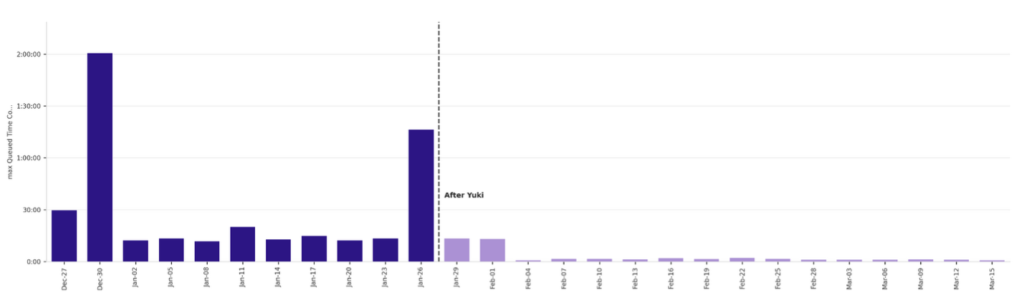
Customer-facing application: daily max queue time (Dec 2025 to Mar 2026). Average queue time fell 81%, peak queue time fell 89% after Yuki deployment.
The story here is simple: the numbers that made production go-live impossible were gone.
After Yuki went live, that risk disappeared.
“Yuki helped us turn our AI agent into something we could scale quickly with high cost efficiency. We protected the customer experience during spikes and stayed disciplined on spend, without adding operational overhead.” Asaf Shamly, Co-Founder & CEO @ Browsi

Intelligent Routing: Run Each Query on the Smallest Warehouse That Still Hits the SLA
Queue pressure drops when you stop forcing every query through the same compute lane.
A key part of how Yuki eliminated queue pressure for Browsi was routing queries to the smallest warehouse that could still meet latency targets.
Queries that didn’t need full 2X-Large compute were automatically redirected to an X-Small warehouse, freeing headroom on the primary warehouse for the queries that actually needed it.
In a typical two-week window right after go-live, Browsi saw that on most days 65% to 78% of queries were handled by the smaller X-Small warehouse with no SLA impact.
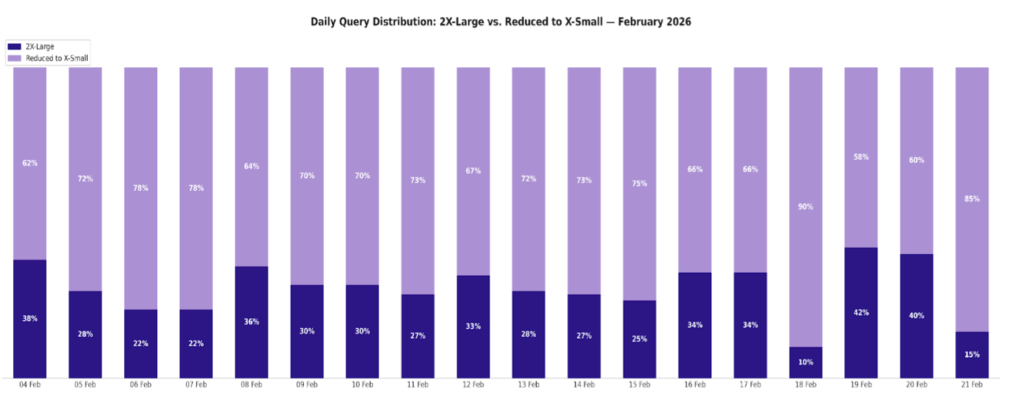
Daily query distribution: 2X-Large vs. Reduced to X-Small, February 2026. Most queries ran on the smaller warehouse, preserving headroom for latency-sensitive requests.
This is what “optimization” should look like in 2026: Automatic routing decisions, per query, in real time.
Cost Reduction: The Side Effect of Getting Routing Right
Browsi didn’t trade performance for cost.
They got cost savings because performance was controlled the right way.
Within the first month of deployment:
- Browsi reduced Snowflake credit consumption by 28%
- 32% of queries were automatically routed to a smaller warehouse
But the more interesting part is what happened as workload increased.
After Yuki went live:
- monthly query volume more than doubled
- from 21K queries in January to 55K in February
- while credits consumed stayed roughly flat
- ending March at 2,661 versus 2,318 before
So yes, savings mattered.
But the real win was that scaling the AI agent stopped meaning scaling the bill at the same rate.
Browsi took the smarter path: they kept performance stable by controlling routing, not by overprovisioning compute.
“Most companies try to solve AI-agent traffic by buying bigger warehouses. Browsi did it the smarter way: they kept performance predictable by controlling routing, not by overprovisioning. That’s exactly what Yuki was built for.”
Ido Arieli Noga, CEO and Co-Founder of Yuki

What This Unlocked for Browsi
Most case studies stop at “we saved X%.”
That is not the point.
The point is what the team can do next because the platform stopped fighting them.
For Browsi, predictable performance and cost discipline unlocked:
- Confidence to scale customer-facing AI usage without fearing SLA regression during spikes
- Faster rollout velocity, because infrastructure stopped being the bottleneck
- Cost predictability as query volume grew, which matters when AI adoption is still accelerating
- Less operational overhead, because optimization didn’t become another engineering job
When you stop running “just in case” warehouses, you stop negotiating every product step with the bill.
Takeaways
AI-agent workloads punish static warehouse sizing
If your traffic is spiky and customer-facing, running one big warehouse is not a strategy. It is a gamble.
Queue time is not a Snowflake metric, it is a product metric
For customer-facing AI, queue time impacts user experience directly. That makes it revenue-impacting infrastructure.
Routing is the cleanest path to predictable performance
Separating lightweight and heavy queries prevents resource contention. Performance stabilizes without needing to overprovision compute.
The best cost optimization is the one that does not steal roadmap time
If savings require ongoing manual tuning, it will lose to product priorities. Automation wins because it runs in parallel.
Savings are great, but predictability compounds
Once performance and spend are predictable, teams move faster. That is the real advantage.
Want to See What You Could Save?
If you are running customer-facing AI agents on Snowflake and you are solving performance spikes by running bigger warehouses, you are not alone.
But you are paying for the least scalable solution.
Yuki helps you keep latency predictable during traffic spikes by dynamically routing each query to the right warehouse in real time, with plug-and-play onboarding and zero manual effort.